

McDonald’s opened 2026 with solid growth across all major business segments, supported by continued strength in value, marketing, menu innovation, and loyalty. Global comparable sales increased 3.8%, while Systemwide sales rose 11% to more than $34 billion. Revenue, operating income, net income, and EPS all increased year over year, with franchised margins continuing to support profitability. Management emphasized that McDonald’s ability to execute consistently in a challenging environment remains a key competitive advantage. The quarter also showed continued momentum in international markets and loyalty engagement, although higher taxes, restructuring costs, and rising operating expenses partially offset earnings growth.
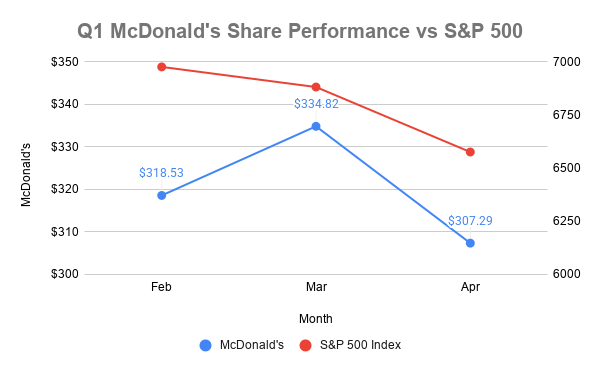
Key Financial Highlights
Q1 2026 revenue increased 9% to $6.52 billion, or 4% in constant currencies. Operating income increased 12% to $2.95 billion, while net income rose 6% to $1.98 billion. Diluted EPS increased 7% to $2.78. Excluding restructuring charges, adjusted EPS was $2.83, up 6% year over year, or 1% in constant currencies. Q1 2026 EARNINGS SUMMARY
Global comparable sales increased 3.8%, including:
- U.S.: +3.9%
- International Operated Markets: +3.9%
- International Developmental Licensed Markets: +3.4% Q1 2026 EARNINGS SUMMARY
Global Systemwide sales increased 11%, or 6% in constant currencies, to more than $34 billion. Franchised restaurant revenue increased 9% to $4.01 billion, while Company-owned restaurant sales also increased 9% to $2.32 billion.
Strategic Initiatives and Market Performance
Management continues to frame its strategy around being “three-for-three”: value leadership, breakthrough marketing, and menu innovation. CEO Chris Kempczinski specifically highlighted those three areas as the reasons McDonald’s continues to deliver what customers want, even in a difficult operating environment.
Market performance was broadly positive. U.S. comparable sales increased 3.9%, primarily because of higher average check. Nearly all International Operated Markets posted positive comparable sales, led by the U.K., Germany, and Australia. International Developmental Licensed Markets grew 3.4%, led by Japan, with all geographic regions delivering comparable-sales growth.
Loyalty also remained a major strategic growth engine. Across 70 loyalty markets, Systemwide sales to loyalty members exceeded $38 billion over the trailing 12 months and more than $9 billion during the quarter, indicating continued growth in digital engagement and repeat customer activity.
McDonald’s also continued its Accelerating the Organization modernization program, recording $47 million in pre-tax restructuring charges during Q1.
Challenges
Despite strong top-line growth, several cost pressures remained. The effective tax rate was a notable headwind, with the income tax provision increasing 21% to $559 million, significantly faster than net income growth. Management specifically noted that higher franchised margins were partly offset by a higher effective tax rate.
Operating expenses also increased. Total operating costs and expenses rose 8%, while other SG&A expenses increased 13%. Company-owned restaurant expenses increased 9%, and other restaurant expenses increased 19%. Interest expense also increased 6%.
Restructuring remains another ongoing expense. McDonald’s recorded $47 million in pre-tax charges in Q1 related primarily to Accelerating the Organization, although these charges were lower than the $66 million recorded in the prior-year quarter.
Outlook
The Q1 earnings release does not provide specific full-year 2026 guidance for revenue, comparable sales, EPS, margins, or restaurant openings. However, management’s messaging remains consistent with the strategy laid out in the 2025 annual report: continue emphasizing value leadership, marketing, menu innovation, loyalty, and disciplined execution.
The strong Q1 comparable-sales performance across all three geographic segments suggests that McDonald’s entered 2026 with positive operating momentum. Key areas to monitor during the remainder of the year include whether U.S. traffic strengthens beyond check growth, whether international markets maintain their current pace, continued loyalty growth, the impact of restructuring, and whether higher taxes and operating expenses continue to constrain earnings growth. Management also notes that future performance remains subject to economic, geopolitical, regulatory, and other risks described in its SEC filings.