

RE/MAX’s second quarter of 2026 showed continued pressure on the standalone business, with revenue, recurring franchise revenue, Adjusted EBITDA, and Adjusted EPS all declining year over year. Total revenue fell 5.8% to $68.5 million, while Adjusted EBITDA declined 12.6% to $22.9 million. The largest operating headwinds remained the decline in U.S. agent count, changes to the Aspire and Ascend fee models, weaker mortgage revenue, and continued investment in technology. At the same time, global agent count still increased modestly because of growth in Canada and international markets, and higher average transactions per agent and home prices helped support broker-fee revenue. Strategically, the quarter remained dominated by the pending transaction with The Real Brokerage, with RE/MAX suspending formal guidance and quarterly earnings calls while the merger process advanced.
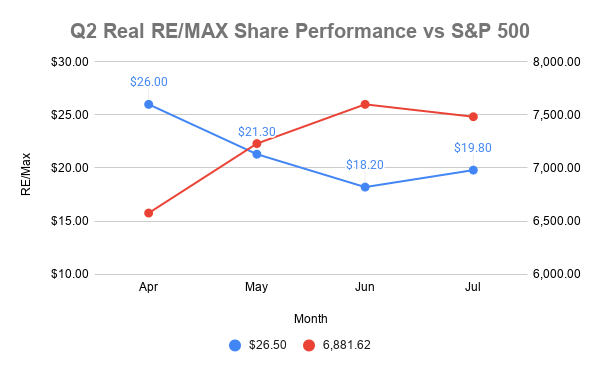
Key Financial Highlights
Q2 2026 total revenue was $68.5 million, down 5.8% from $72.8 million in Q2 2025. Revenue excluding the Marketing Funds was $51.7 million, down 5.1%, reflecting negative organic revenue growth of 5.1%.
Recurring revenue from continuing franchise fees and annual dues declined 9.9% and represented 63.9% of revenue excluding the Marketing Funds, versus 67.3% a year earlier.
Adjusted EBITDA declined 12.6% to $22.9 million, while Adjusted EBITDA margin fell to 33.5% from 36.1%. Adjusted EPS was $0.32, compared with $0.39 in Q2 2025.
On a GAAP basis, RE/MAX reported a $6.8 million consolidated net loss and a $4.3 million net loss attributable to RE/MAX Holdings, compared with $4.7 million of attributable net income in the prior-year quarter. GAAP diluted EPS was $(0.20).
For the first six months of 2026, revenue was $138.7 million, versus $147.2 million in the prior-year period. Adjusted EBITDA was $38.5 million, down from $45.6 million.
Cash and cash equivalents were $112.4 million at June 30, while outstanding debt remained high at approximately $435.0 million.
Strategic Initiatives and Market Performance
The most important strategic initiative remained the proposed combination with The Real Brokerage, under which Real would acquire RE/MAX Holdings and form Real REMAX Group Inc. At the time of the Q2 report, the transaction was still expected to close in the second half of 2026, subject to shareholder approvals and other closing conditions.
RE/MAX also continued investing in its technology platform, flagship websites, Marketing Studio, and updated economic models, including Aspire and Ascend. These initiatives are intended to modernize the franchise value proposition and support long-term competitiveness, although they are creating some near-term pressure on revenue and margins.
Agent trends remained mixed. Total agent count increased 1.5% to 149,267, but this was driven by growth outside the U.S.:
- U.S. agents declined 5.0% to 47,170.
- Canada increased 3.3% to 25,798.
- Agents outside the U.S. and Canada increased 5.3% to 76,299.
Broker fees were one relative area of strength. Revenue from broker fees increased to $14.1 million from $13.5 million, supported by higher average transactions per agent and higher average U.S. home-sale prices.
Challenges
The biggest operational issue remained the decline in the U.S. agent base, which fell 5.0% year over year. This continued to weigh on franchise-fee revenue and recurring revenue.
The Aspire and Ascend programs also continued to reduce reported revenue in the near term. Management specifically cited changes to these fee models, lower U.S. agent count, and weaker mortgage revenue as major reasons for the 5.1% decline in organic revenue.
Merger-related costs became a significant expense. Q2 included $11.5 million of merger transaction costs, compared with none in the prior-year quarter. Total operating expenses increased 14.1% to $67.0 million largely because of these transaction costs.
Cash generation was also weaker year to date. Operating cash flow for the first six months was $4.3 million, down from $10.2 million a year earlier, while adjusted free cash flow fell to $3.4 million from $9.8 million. Unencumbered cash generated declined to just $1.1 million from $7.5 million.
Debt remains another important constraint. With approximately $435 million of debt and quarterly interest expense of roughly $7.2 million, leverage continues to consume a meaningful portion of earnings and cash generation.
Outlook
RE/MAX did not provide quarterly or annual guidance because of the pending merger with Real, and management also suspended quarterly earnings calls while the transaction remained in process.
The near-term outlook therefore centered on completing the transaction and preparing for integration into Real REMAX Group. The company identified several merger-related uncertainties, including retention of agents and franchisees, integration execution, achievement of expected synergies, leverage reduction, transaction costs, and the possibility that benefits could take longer than expected to materialize.
From an operating perspective, the key items to watch were whether U.S. agent declines could stabilize, whether Aspire and Ascend ultimately improve franchisee economics despite near-term revenue pressure, whether technology spending improves the franchise value proposition, and whether stronger international growth can continue to offset U.S. weakness.
Overall, Q2 2026 reinforced the same transition story seen in Q1: the legacy RE/MAX business remained under pressure, particularly in the U.S., while management’s strategic focus increasingly shifted toward completing the Real transaction and positioning the combined company around greater scale, technology, and operating efficiency.